
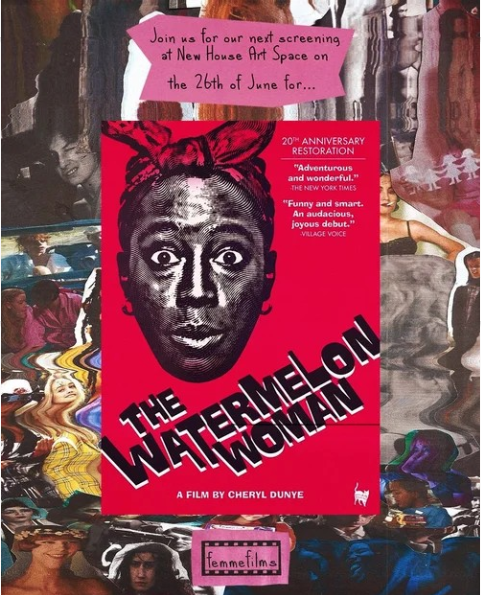
The Watermelon Woman
The Watermelon Woman stars Dunye, playing a version of herself who works in a video store while searching for a forgotten black actress from the 30s credited only as “The Watermelon Woman”.
What begins as a DIY documentary project slowly becomes something richer: a meditation on who gets remembered, who gets erased, and who has the power to tell stories. Dunye places herself at the centre, not as an authority, but as a participant who is curious, flawed, funny, and openly subjective. The film understands that objectivity has often been the tool of erasure, not truth.
Cheryl Dunye turns absence into inquiry, using humor, warmth, and invention to confront how black queer histories are erased, misfiled, or never recorded in the first place. The Watermelon Woman is a film that feels quietly radical not because it announces its importance, but because it refuses to ask permission to exist The Watermelon Woman not only stands against the erasure of marginalised stories in the face of white patriarchal power, but depicts an abundance of joy too. Friendships unfold with lived-in ease, romance is awkward and sincere, and the film’s low-budget aesthetic becomes a strength rather than a limitation. It feels intimate, handmade and alive. Every choice reinforces the idea that representation isn’t just about visibility, but about control who tells the story and how. Dunye’s film doesn’t just critique that absence it fills it, lovingly and defiantly.
It’s funny, intimate, political, and deeply personal all at once. By the time the film ends, you realize you’ve watched something both historically vital and incredibly charming. The Watermelon Woman looks back in order to create a future archive where people like Dunye are impossible to erase.
Even decades later, it feels fresh. Not just because of its themes, but because of its voice: playful, sharp, and unapologetically queer.
REVIEWS: “…layered with intelligent ideas about the complexities of power and love…”
Time Out New York
“…everything a first feature should be, fast and loose, breathless and beautiful…”
Philadelphia City Paper
Find us
New House Arts Space & Fridas Coffee House, Fays Passage, Bedford Road, Guildford